Friday, 18 November 2022

How to get the most out of your digital mini soil testing machine?


A nutrient shortage is a big issue in India, and farmers frequently use fertilisers against expert advice. This raises production costs, reduces farm income, and deteriorates soil health. The finest features that distinguish our Digital Soil Testing Kit are its dependability, portability, and excellent quality. It is portable and has the capacity of a tiny laboratory. It is appropriate for agricultural service departments, agricultural dealers, and fertiliser producers to test soil and identify major and secondary nutrients, as well as perform up to 100 tests. We are capable of addressing mass demands and providing items at reasonable pricing.


Who is the Kisaan Helpline?


Kisaan Helpline, one of India's top agricultural service provider portals, supports rural communities in increasing the efficiency and sustainability of their agricultural operations. We assist farmers in being more connected, integrated, and knowledgeable than they have ever been. We provide specialist knowledge ranging from ground preparation, seeding, sowing, plant nutrition, protection, and harvesting. We are India's top Agricultural Service Provider, assisting you to make farm decisions and increase performance, forecast what will happen in the future, and respond more effectively as projected.


Kisaan Helpline is a full-stack data-driven technology platform dedicated to farmers, with the goal of empowering farming and farmers' intelligence. Our research data assists farmers in finding a better solution for 150 crops until harvest.


We give rural youngsters, individual farmers, and organisations the opportunity to set up their own micro lab for a soil health examination.


For the purpose of sustaining soil health, we will put up a micro-soil lab at the block level or as close to the farmer's reach as possible, to provide better guidance on plant nutrition and soil texture improvement, as well as to promote organic farming to save soil.


What exactly is the Kisaan Helpline Digital Soil Testing Mini Lab?


The Kisaan Helpline Digital Soil Testing Mini Lab is a sophisticated digital soil testing kit. It examines 14 soil characteristics, suggests crop-specific fertiliser doses for 100 crops, generates soil health cards, has a 6-hour battery backup, and can be charged using solar energy.


The Digital Soil Testing Mini Lab has been approved by the Ministry of Agriculture of the Government of India and is being utilised in the Government of India's Soil Health Card project.


The Advantages of a Digital Soil Testing Kit


• Simple to use.

• Provides soil testing results in the least amount of time.

• This is the most cost-effective method of scientifically assessing soil.

• After a brief training period, anyone can operate it.

• 14 soil parameters are tested.

• It recommends crop-specific fertiliser doses for over 100 crops.

• Testing reports help to optimize fertiliser use.

• Farmers' agricultural yields increased as a result of the testing results.

• increases farmers' profits while decreasing their spending.


The Benefits of a Digital Soil Testing Kit


• 14 soil parameters are tested.

• Over 100 crops have crop-specific fertiliser dosing recommendations.

• Mobile connectivity via Bluetooth..

• USB computer connectivity

• Built-in thermal printer.

• The technology has been authorized by the world's foremost agricultural institute.


14 Parameters Tested by Digital Soil Testing Kit


• Organic Carbon (OC)

• Available Nitrogen (N)

• Available Phosphorus (P)

• Potassium (K) readily available

• Zinc (Zn) is readily available.

• Sulphur (S) readily available

• Boron (B) readily available

• Copper (Cu) readily available

• Available iron (Fe)

• Available Manganese (Mn)

• Electrical Conductivity (EC)

• PH

• Soil Acidification Test for Acidic Soil

• Alkaline soil gypsum requirement test


Who is eligible to use the Digital Soil Testing Kit?


• Farmers will be able to test their soil thanks to the efforts of government agencies and laboratories.

• Rural youth will establish a soil testing lab.

• Farmers are starting a soil testing lab.

• NGOs will provide farmers with free soil testing.

• Agri-input firms will provide soil testing and promote optimal fertiliser usage among farmers.

• Agri-input dealers will provide farmers with soil testing services in addition to selling agri-inputs.

• Soil testing will be taught in agricultural institutions and universities.


Conclusion


Kisaan Helpline, one of India's leading websites for agricultural service providers, can help rural communities boost the productivity and sustainability of their agricultural operations. Farmers are encouraged to become more involved, connected, and knowledgeable. We offer specialised knowledge ranging from soil preparation and planting to plant nutrition and protection. We are India's largest provider of agricultural services, assisting you in making farm decisions, enhancing performance, predicting forthcoming events, and responding more successfully as expected. Please contact us at any moment to obtain our Digital Soil Testing Kit.

Thursday, 17 November 2022

How soil testing helps our modern farmers?


What exactly is soil testing?


A soil test is performed to determine several properties such as nutrient content, composition, acidity, pH level, and so on. Soil testing can serve a variety of objectives depending on the sector.


Soil testing is used in agriculture, for example, to assess soil moisture levels, check for probable contamination, improve crop output, and so on. Some soil tests are conducted in the field while others are conducted in laboratories. This article is about how soil testing can help our modern farmers improve their harvest.


Soil testing is critical in many industries for obvious reasons. Soil fertility accounts for 60% of crop yields in agriculture. As a result, ensuring high soil quality is as vital as other aspects of farming.


Let's Take a Closer Look at the Importance of Soil Testing:


1. Locates polluted soil


Soil testing procedures not only resolve farmer concerns, but they are also beneficial to the ecosystem. Many companies, businesses, and even residential and commercial structures release toxic chemicals into the land or water (which ultimately gets mixed with nearby soil). The soil loses its fertility and becomes an environmental hazard in such circumstances. Soil testing can be quite useful in avoiding such occurrences. Furthermore, numerous open spaces are exploited to dump rubbish and plastic without adequate garbage disposal. Soil testing can aid in the prevention of such areas. The process not only assists in determining which contaminating substances are present in the soil, but it also assists in determining what steps should be implemented.


2. It increases soil productivity


Farming requires research before beginning. Everything from weather to soil efficiency must be examined to assure farm output. A soil test informs farmers about the quantity of nutrients currently present in the soil and how much more is required. It contributes to better consistency of nutrient availability across fields, resulting in more uniform crop development. It also aids in the examination of soil structure, texture, and colour, as well as the nutrient level and pH content. Farmers may use these test results to determine what can be done to enhance the soil quality on their properties.


3. It indicates the quantity of fertiliser to be applied


Understanding the precise shortage in the soil can assist farmers in taking the necessary steps. Fertilizers are used to deliver more nutrients to plants, increase agricultural output, and make lawns greener. Inorganic fertilisers, such as potassium and phosphorus, are scarce resources. Such fertilisers can be avoided if the soil does not require them. Soil testing can be used to determine which fertilisers to use and how much to use. It also keeps over-fertilization at bay.


4. Assists in construction


Soil testing evaluates the carrying capability of the soil as well as its structural stability. Soil testing is done at the start of building projects to minimise exposure to unanticipated threats.


5 reasons why you should test your soil:


1) Educate yourself on soil conditions and how to improve them


Fertile soils are required for optimum crop growth. To enhance soil fertility, it must first be measured. The chemical, physical, and biological qualities of soil affect its fertility. The texture, colour, and structure of the soil are evident. However, the chemical makeup of soil cannot be seen. This is what has to be quantified, which is why soil sampling is so important. Soil tests are performed to assess a soil's nutrient content and pH level. With this knowledge, the precise type and quantity of fertiliser required to enhance soil fertility may be determined.


2) It is the initial step in managing soil fertility


Farmers may boost agricultural output by maximising the efficiency of nutrients and water utilization with a comprehensive soil fertility management approach. Soil testing is the first step toward good soil fertility management. Soil testing provides useful information and assists you in improving the health of your soil.


3) Lower fertiliser costs


If you know the exact type and quantity of fertiliser your soil and crops require, you will not waste money on superfluous fertilisers. Furthermore, inorganic fertilisers in general, as well as nutrients such as phosphorus and potassium, are scarce resources. Their costs have risen over the years, and because this tendency is expected to continue, it is prudent to prepare for the impending adjustments now.


4) Avoid overfertilization


Applying fertiliser without first determining your soil's nutrient requirements may result in over-fertilization. You may prevent applying too much fertiliser by evaluating your soils and acquiring fertiliser advice. This is beneficial to both your crops and the environment. Over-fertilization of crops results in fertiliser burn and yellowing foliage. It may also cause nutrient leaching, water contamination, and lasting harm to aquatic life in the surrounding area.


5) Avoid soil deterioration


Every farmer faces a challenge from soil deterioration. It is estimated that 24 billion tonnes of productive soil are lost each year owing to erosion caused by improper soil management. Soil testing, followed by the application of the appropriate fertilisers at the appropriate time, ensures optimal soil management. Aside from reducing the hazards of soil deterioration, it is a more efficient and financially appealing method.


About Kisaan Helpline


The major purpose of the Kisaan Helpline is to share and disseminate information collected via agricultural research, expertise, and experience around the agricultural sector in order to help in the growth of agriculture through the use of information technology. Our main goal is to consolidate all information on a single web platform, reach out to farmers, and empower and inform them. 160+ Crops via 25+ Agriculture Experts, Technologies, Crop Protection, Crop Nutrition, Fertilizers, Pest and Disease Management, New Agriculture Training, Krishi Digital Magazine (Agriculture Newspaper), Krishi Fairs (Agri Events), Agriculture News, Government Schemes, Market Rates (Mandi Bhav), etc.


Now that you know what we are all about, let’s help with finding out how we could help out modern farmers test their soil for enhancement of production. We give rural children, individual farmers, and organisations the opportunity to set up their own micro-laboratory to assess the health of the soil.


Among the parameters we evaluated were:


• Organic molecule

• Available nitrogen (N)

• Available phosphorus (P)

• Potassium (K) readily available

• Copper (Cu) is available.

• Available Manganese (Mn)

• Electrical conductivity

• Zinc (Zn) readily available

• Sulphur (S) available

• Boron (B) readily available

• Available iron (Fe)

• Test for Acidic Soil Gypsum Requirement for Alkaline Soil pH


Conclusion -


There is currently an interest in whether soil testing can be used to identify whether the application of fertilisers and/or waste products may pollute surface and ground waterways. Soil testing to determine the possibility of an environmental impact may be useful, but only if a complete strategy is implemented. Response criteria for other applications of soil testing have not been as thoroughly established, and links are frequently intuitive or dependent on a team of scientists' best professional opinion.


Although agronomic responses have been employed as surrogates for other secondary impacts, such as water quality deterioration, this approach is conservative and fails to account for the presence of infield soil processes, numerous loss-pathways, and nutrient-retaining activities beyond the field's border.


Soil testing is an important aspect of many industries. We advocate employing experienced and knowledgeable soil testing service providers because it involves a variety of methods and kinds. In-house soil testing should not be used since the test results indicate the quality of the soil. Green Solution offers a specialised soil testing team composed of competent and experienced individuals. Please contact us if you require any other information.

How can the Kisaan Helpline Mobile Application simplify your life?


What is the Kisaan Helpline?


A dedicated or dedicated digital platform to improve farmer's lives and empower sustainable agriculture. Agriculture in India is being transformed.


Kisaan Helpline, one of India's top agricultural service provider portal, supports rural communities in increasing the efficiency and sustainability of their agricultural operations. We assist farmers in being more connected, integrated, and knowledgeable than they have ever been. We provide specialist knowledge ranging from ground preparation, seeding, sowing, plant nutrition, protection, and harvesting. We are India's top Agricultural Service Provider, assisting you to make farm decisions and increase performance, forecast what will happen in the future, and respond more effectively as projected.


Enabling Sustainable Agriculture in India


The major purpose of the Kisaan Helpline is to distribute and disseminate information collected via agricultural research, expertise, and experience around the agricultural sector in order to aid in the development of agriculture through the use of information technology. Our main goal is to consolidate all information on a single web platform, reach out to farmers, and empower and inform them.


Research materials, soil testing, water testing, cutting-edge farm equipment and technology, weather forecasting, consulting, and a variety of other services are all available. Our farmers will become a part of "Smart and Digital India" by utilising this knowledge. Download and use the Kisaan Helpline Mobile Application to become a "Smart Farmer" and obtain the best farmer services.


What makes KH (Kisaan Helpline) unique?


1) Agriculture News: Farmers want news about their field, as well as information about the current value of farming. As a result, we update news and ideas on the kisaan helpline portal on a daily basis. Farmers can easily read and comprehend the news; hence, we post it in both Hindi and English. We are attempting to make it available in all regional languages. Our new system is really powerful, and it includes informatics to assist farmers.


2) Market Price (mandi rate): Farmers are always interested in the market value of their harvest (mandi). They constantly seek the best crop costs; thus, we provide the best option for farmers. Farmers can use our portal.


3) Agriculture Training: Kisaan Helpline wishes to educate farmers through agriculture training. We provide a really appealing platform for farmers. We are organizing all types of agriculture training programmes in this section. The user can learn about any topic linked to agriculture. Farming is a very large and helpful area; thus, we are developing a really appealing and suitable programme for farmers. They can obtain correct information from this source.


4) Suggestions and Solutions: Farmers need to express their problems, difficulties, questions, and suggestions, but many are unsure how to do so. Farmers can easily ask questions in this part, and our qualified team will respond to all inquiries. This is a system of assistance and support. Farmers can obtain an accurate response in a timely manner.


5) Farming Technique: Due to incorrect farming techniques, farmers are unable to obtain crop quality as expected, and so are unable to give the required crop value. As a result, the expert team at Kisaan Helpline will supply you with the best farming strategy. Farmers may readily obtain accurate information about farming techniques. Our specialists will offer you the greatest advice and knowledge. Will they make suggestions on what to do? And why is it advantageous for farming?


6) Digital Magazines: Kisaan hotline also has a digital magazine part for farmers' assistance and knowledge improvement. Farmers can use the traditional farming method and receive greater results in their agricultural fields after reading our online digital magazine. We have a diverse assortment of extremely rare magazines. which periodicals are not available everywhere, online or offline Farmers can obtain digital magazines through a simple approach. The farming method is strongly supported by digital magazines. Our professional agrologists agree that this is beneficial.


Why Should You Pick Us?


1) Sources of Information


For the most recent upgrade, we have a robust research team. KH saves data from previous years to assist farmers in finding answers and resolving crop management difficulties.


2) Innovation


Our forthcoming AI will be available to farmers 24 hours a day, seven days a week. Farming requires innovation, and we are enthusiastic inventors.


3) Solution and live assistance


Salah and Samadhan are one-of-a-kind tools for answering farmers' questions.


Kisaan Helpline App


1) Farmer Service Provider Online Portal-India's Sustainable Advanced Farming System


The Kisaan Helpline Mobile Application is a dedicated Kisan platform that offers farmers one-stop services. Kisaan Helpline is a set of village-level online portals that currently provide a variety of services to farmers. Kisaan Helpline has built a niche for itself by assisting over 1.5 lakh farmers across India in adopting aware and smart farming practices.


2) What services does the Kisaan Helpline provide?


agriculture professionals and our team, in which all farming knowledge is made available to farmers for free. Kisaan Helpline offers over 160 crops and varieties, with over 25 agriculture experts covering every type of information relating to crops and farming, such as Rabi, Kharif, Herbal, Vegetable, Phal-Phool, and much more.


3) Kisan Helpline's Key Services


Many crops, technologies, pest and disease management, seeds and fertilisers, new agriculture training, agriculture digital magazine, agriculture fairs, agriculture news, government schemes, market rates by our expert team, research materials, soil testing, water testing, latest agricultural technology, weather forecasting, consultancy, and many other services are included. Using these farmers helps them become better farmers.


Bottom Line


Kisaan Helpline strives to eliminate information asymmetry by providing farmers with weather forecasts and mandi prices. We ensure that a variety of items are available on time, and we also provide new product developments to farmers. Farmers' production costs are reduced since products purchased from Kisaan Helpline are less expensive than those on the market. We recommend that you give us a chance to serve you with our services. Please contact us at any time if you have any questions.

Agriculture magazines appear to assist our farmers; read on to learn how


Magazines are an important source of information for keeping up with global developments. They do not offer daily news updates like newspapers do.


These communicate the message to us through text, graphics, and other media. Agriculture journals also serve a similar purpose. They keep readers up-to-date on the most recent technological advances from around the world.


What exactly is an agricultural magazine?


The Agriculture Magazine is a monthly peer-reviewed, open-access publication that was founded with the goal of distributing knowledge about cutting-edge technology and practices developed in agriculture and associated industries.


In addition to agriculture, it stresses environmental issues because they are currently more relevant and demand agriculturalists' attention. This magazine provides a place for academics, scientists, students, forward-thinking and imaginative farmers, and any other members of the scientific community to contribute their unique ideas by publishing articles that address both current and future requirements. The Agriculture Magazine also seeks to provide a platform for a range of agro and agri-tech start-ups to present their success stories, business plans, and objectives, fostering innovation among brilliant minds.


The articles may come from a wide range of fields, including agronomy, soil science, horticulture, plant breeding, plant protection, agriculture extension, economics, forestry, seed technology, animal husbandry and dairy, fisheries, sericulture, irrigation science, agricultural engineering, veterinary, agri-business management, natural resource management, botany, home science, ecology, biochemistry, biotechnology, waste management, environmental sciences, community science, and post-secondary education.


The Significance of Online Magazines—Easy Access


- Accessibly simple.


When a person subscribes to a magazine, they will receive an email with the essential login details. By doing so, the reader can begin downloading the necessary problems. If you subscribe to digital periodicals, you won't have to keep looking for new editions. You will receive all notifications as soon as something new occurs.


- You may be able to interact with more people.


The capacity to reach readers across all demographic and geographic barriers is one advantage of digital publication. This is critical for retaining client loyalty and interests.


- Quick distribution and publication.


Using digital magazines, a publisher may immediately engage and interact with a specific audience. Many readers of digital publications read the magazine on the day of publication.


- Digital magazines reduce revenue losses caused by unsold stock.


Software for digital journals can be sold without incurring additional logistical expenditures. It also safeguards against the losses caused by unsold copies.


- Publishers run the risk of losing their readers.


Consumer awareness necessitates a two-way discussion. Publishers can easily discover how readers interact with the magazine thanks to e-publishing technologies.


The renowned agriculture periodicals are:


Agri Mech


It is a monthly publication on farm mechanisation and one of the leading publications in agricultural technology. RK MEDIA AND COMMUNICATIONS produces it in India and distributes it to key agricultural experts throughout the country in 15,000 hard copies and 350,000 online readers worldwide.


Horticulture in India


It is a semi-technical English publication published bimonthly.


It was founded in 1956 with the goal of disseminating information on the most recent methods of cultivating fruits, vegetables, and flowers. Fruit, vegetable, floral, gardening, landscaping, plantation crops, and medicinal and aromatic plant cultivation are all included.


Today's Agriculture


Agriculture Today has remained successful throughout the years due to its broad content and unusual and eye-catching style of delivering critical information. The magazine has evolved into a vital and ideal medium for spreading broad market and industry information; economic and policy concerns; scientific breakthroughs; new agri-input items; new technology; and the most recent news and analysis on agricultural developments.


A farmer from India


Agriculture is the primary industry in rural India. Transferring scientific technologies and information to farmers and decision-makers must be high on the priority list. The Indian Farmer is a monthly publication that publishes agricultural, veterinary medicine, home science, and fisheries research. It has the ISSN number 2394-1227.


Concerning the Kisaan Helpline


Kisaan Helpline, one of India's leading websites for agricultural service providers, can help rural communities boost the productivity and sustainability of their agricultural operations. Farmers are encouraged to become more involved, connected, and knowledgeable. We offer specialised knowledge ranging from soil preparation and planting to plant nutrition and protection. We are India's largest provider of agricultural services, assisting you in making farm decisions, enhancing performance, predicting forthcoming events, and responding more successfully as expected.


Kisaan Helpline offers a variety of e-magazines in a variety of languages to help farmers learn more about farming.


To summarize


With digital technologies, there is a lot of promise for enhancing agricultural livelihoods. The government must alter current laws to make Indian agriculture more market-oriented while also encouraging technological innovation. Rural connectivity is critical for supplying information and low-cost data. Fair market access will help farmers boost their profitability while also allowing rural kids to reach their full potential.


As a dedicated digital platform to enhance farmer livelihoods and facilitate sustainable agriculture, Kisaan Helpline will be delighted to answer any questions you may have.

Wednesday, 16 November 2022

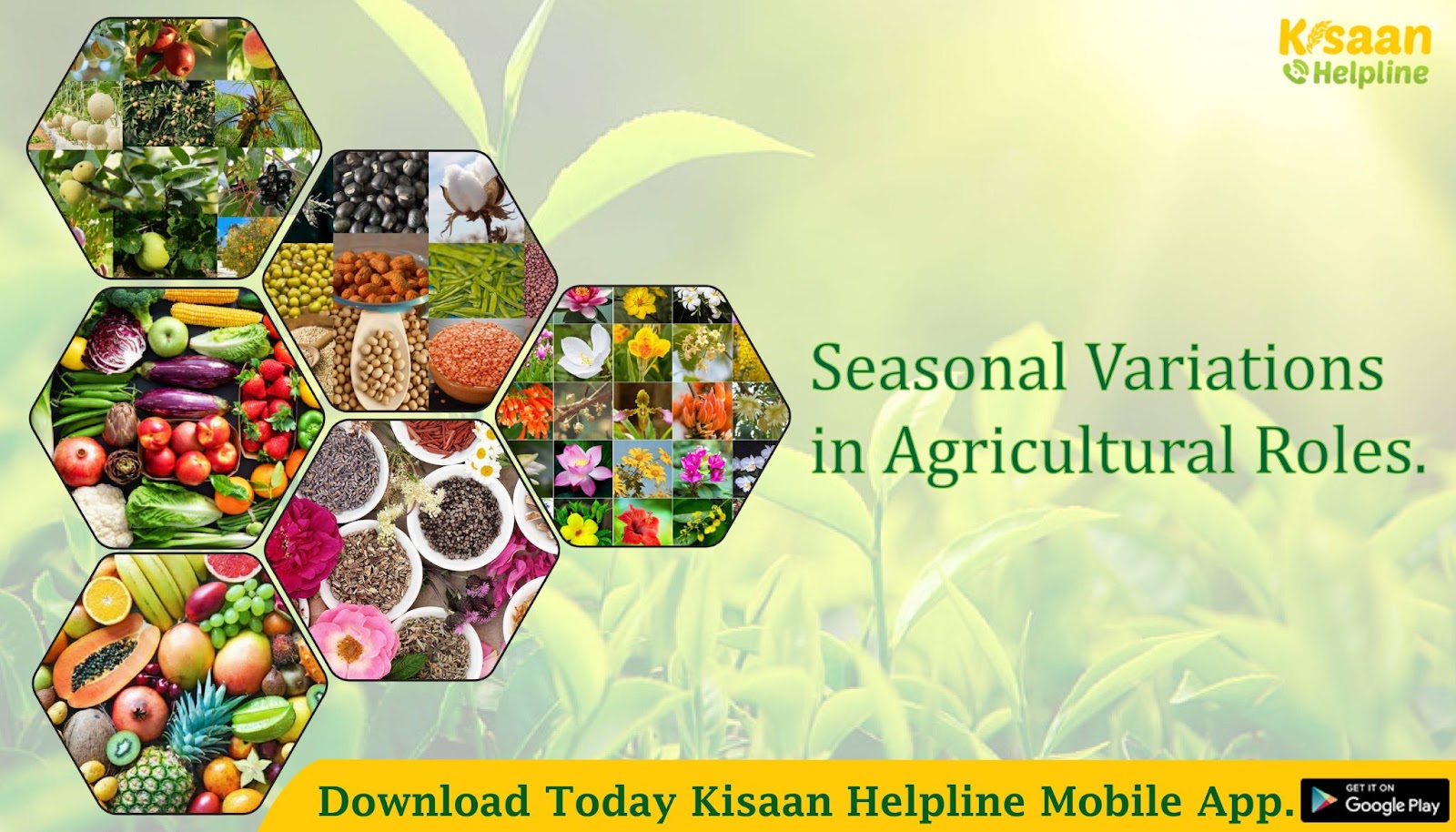
Seasonal variations in agricultural roles


Seasonality is defined as the cyclical shift in food supply and agricultural labour caused by climate fluctuations in the rural areas of LDCs (LDC). In seasonal climates, a poor, lean, or slack season, also known as the saudure (French for the intersection of two agricultural cycles), occurs for 2-3 months every year, frequently coinciding with rains, causing cyclical stress on rural communities' health and nutrition.


Agro Climatic seasonality is important among people that practices subsistence agriculture and hunter-gatherers, as well as in other agricultural systems where background food security is low, such as locations where commercial crops are mostly cultivated. Seasonal variation plays a very important role when it comes to agriculture.


Changes in rainfall, temperature, wind exposure, and relative humidity, in relation to the water retention capacity of the soil, cause a cyclical shift in water balance, which may limit the period for plant development to certain times of the year. The proportion of dry months in a year, known as absolute seasonality, can range from 0 (enough rain all year) to 1.


If the vegetative cycle of corn (maize) is taken into account (120 days), the following places in the world can be classified: Low seasonality occurs when the vegetative season lasts more than 200 days each year and two harvests are feasible; moderate seasonality occurs when the vegetative season lasts 120-200 days and one to two maize harvests are possible.


Crops Definition


A crop is a large-scale plant that is farmed or grown. Crops are often grown to be commercially traded. In other words, a crop is any plant that is widely farmed and harvested for profit.


Crop Varieties


India grows two primary types of crops. To be specific, Kharif and Rabi Let's have a look at some of these.


Kharif cropping


Because the season corresponds with the beginning of autumn or winter, the name "Kharif" is Arabic for autumn. Because these crops are grown during the monsoon season, the Kharif crop is also known as the monsoon crop. The Kharif season varies by state, although it normally lasts from June through September.


1) Rice


As previously stated, India is the world's second-largest producer of rice, after only China. India accounts for around 20% of global rice output. It is, without a doubt, the most significant agricultural crop grown in the country. Rice is a staple meal in India, and its cultivation is extensive.


Rice thrives in locations with considerable rainfall. It requires average temperatures of 25°C and a minimum rainfall of 100 cm. It has historically been produced in flooded rice paddy areas. The country's largest rice-producing areas are the northeast plains and coastal areas.


2) Maize


Maize is India's third most significant grain crop, after rice and wheat. It accounts for almost one-tenth of India's overall agricultural output. Maize cultivation is concentrated in Andhra Pradesh and Karnataka. Temperatures ranging from 21°C to 27°C and rainfall ranging from 50 cm to 75 cm are required.


Rabi crops


Spring is the Arabic equivalent of the word "Rabi." The term comes from the fact that these crops are harvested in the spring. Rabi season typically begins in November and lasts until March or April. Since the monsoon season has ended by November, the Rabi crop is mostly grown by irrigation. In fact, unseasonal rains in November or December can wreak havoc on the crop. Farmers plant the seeds in early October, anticipating a spring harvest. Wheat, barley, mustard, and green peas are among the most important rabi crops grown in India.


1) Wheat


India is the world's second-largest wheat producer. Its agricultural revenue is heavily dependent on the rabi harvest. Wheat is a staple diet for Indians, particularly in northern India.


During the growing season, wheat requires temperatures ranging from 14°C to 18°C.Rainfall of around 50 cm to 90 cm is good. Wheat, on the other hand, demands strong sunlight and somewhat warmer temperatures during the harvesting season in the spring. Uttar Pradesh is India's leading wheat-growing state, followed by Punjab and Haryana.


2) Mustard


Mustard is a member of the "Cruciferae" family. Because the oil derived from mustard is edible, we use mustard in cooking in India. It requires a subtropical environment that is dry and chilly to flourish. Mustard grows best at temperatures ranging from 10°C to 25°C. Rajasthan has the highest mustard production in India.


Farmers report considerable fluctuations in the timing and pattern of precipitation within seasons, including:


• More erratic rainfall, falling at inconvenient times both in and out of season;

• During the rainy season, extreme storms and extremely heavy rainfall are interspersed by extended dry intervals.

• In many locations, the onset of the rainy season is becoming more unpredictable;

• Short or transitory second rainy seasons are getting stronger than usual or have vanished entirely.


Growth and the environment


In healthy children, seasonal fluctuations in growth rates have been documented. Palmer14 discovered that growth rates for height are higher in the spring and summer, whereas rates of weight gain are higher in the fall (autumn) and winter. Weight gain is typically greatest between September and November, and can be up to five times that of the minimum months of March to May.15 Between September and February, almost two-thirds of the annual weight gain occurs.


About Kisaan Helpline


Kisaan helpline online portal providing agriculture world service means Indian crop information of rabi (wheat, garlic, chickpea, cumin, onion, mustard, rabi vegetables, pea, opium, coriander, barley, strawberry and oat), Kharif (urad, cotton, maize, onion, vegetables, ginger, rice, moong, sorghum, pearl millet/bajra, finger millet/ragi (cerealAll the mentioned information's purpose is to provide details about the crop name, variety, yielding, and basic queries.


We provide the following services:


1) Rabi Crops: Rabi crops are winter crops. They’re harvested in October or November. In the spring, the crops are harvested. Because they are cultivated in arid locations, these crops need constant watering. Rabi crops cultivated in India include wheat, gramme, and barley.


2) Kharif Crops: Rice, maize, sorghum, pearl millet/bajra, finger millet/ragi (cereals), arhar (pulses), soyabean, groundnut (oilseeds), cotton, and other crops are grown during the kharif season. Wheat, barley, oats (cereals), chickpeas/gram (pulses), linseed, mustard (oilseeds), and other crops are rabi crops.


3) Vegetable plants - a vegetable is more clearly defined as "any plant, a portion of which is utilised for food," with a secondary definition being "the edible component of such a plant." A more specific definition would be "any plant component used for food that is not a fruit or seed, but includes ripe fruits eaten as part of a major meal."


4) Herbal Plants - Herbs can occur in a variety of forms, including leaves, roots, flowers, seeds, root bark, inner bark (cambium), resins, and pericarp. Herbs have many cosmetic applications, including face creams, scrubs, lipsticks, natural scents, and body oils.


5) Phal Phool Tree - Fruit cultivation covers numerous crops, but the most common fruits are mango, banana, grapes, amla, apple, walnut, almond, plum, dates, guava, kinnu, lemon, lime, and mandarin oranges. Orchid Tree (Kachnar), Lady's Slipper, African Marigold, Lotus, Palash, Golden Shower tree, Lilium candidum, Siroi lily, Red Vanda, Rhododendron, Ashoka, Rohira, Noble orchid, Glory lily, Ranawara, and Nag Kesar are the most common crop names.


Conclusion


We hope this blog on seasonal variation has taught you something new, and if you'd like to learn more about comparable topics, please contact us at any time. The Kisaan Helpline would gladly assist you in any way!