Monday, 1 November 2021

Where to get agricultural training?


The agriculture sector is a growing sector and is in great demand. India being an agricultural country has been ranked third with a contribution of 16% to India's GDP. So starting a career in the agriculture sector or modernizing your farming tradition with the best agriculture training will always be a great option.


With Kisaan Helpline, you can get a detailed, practical guide to modern farming.


You can get practical experience, personalized guidance with the best agriculture specialists. We are here to provide you with a complete training program for various agriculture domains. Our training program includes Pearl Culture Training, Agricultural Waste Management, Vegetable Production, Mushroom, Hydroponics and Aquaponics, Organic Farming, Dairy Farming, Soil Health, and a complete guide to many other agricultural programs. Get training for all agriculture guidance at one place on Kisan Helpline. For more information, contact us now: https://www.kisaanhelpline.com/agriculture-training-programs


Since our crops are in great demand all over the world due to their rich quality, nowadays various agro-based industries have been established to meet this demand. You too can start your own agro-based industry or sharpen your agricultural skills with its modernization and convert agricultural skills into your potential source of income. With Kisaan Helpline Krishi Kheti Training, you can do so lately, come to us now and take advantage of your opportunity. Download Kisaan Helpline Mobile Application: https://play.google.com/store/apps/details?id=ample.kisaanhelpline

Saturday, 30 October 2021

How to get complete details of Agriculture Upcoming Programs?


Events like Agriculture Expo, Exhibition, International Meet, are the best way to adapt, enhance skills and learn more about a particular domain then how others are looking for it to be well aware of latest technology in the agriculture sector Huh. It is good to participate in such events, but the problem is where and how to collect the exact details of an expo event.


From Kisaan Helpline you can get complete information about all upcoming agriculture events. Our full details include the exact time to visit, what you'll find there, how important and iconic the event will be, and more. To get complete information about our service and get complete guide for any event visit: https://www.kisaanhelpline.com/agriculture-events


Agriculture programs allow you to find the most suitable way to compete for the world in agri-industry, Expos allow you to know the developments in industries, this you can easily achieve with Kisan Helpline.


Krishi program is a dedicated platform for the agriculture sector, from agriculture events farmers can know about a new revolution and update in farming. Get information about Agriculture Program Indore, Agriculture Program Delhi, Agriculture Program EIMA Delhi, Agriculture Program Pune, etc.

Wednesday, 27 October 2021

What Practices Make Agriculture Sustainable?


Large-scale farms have grown the same crops year after year while using enormous quantities of chemical pesticides and fertilizers, depleting soil fertility, polluting water sources, polluting air quality, and altering climate for decades. In addition to squandering and degrading the resources on which it relies, this system is not designed to be sustainable.


However, a rising number of forward-thinking farmers and scientists, and platforms like Kisaan Helpline are pursuing a different route, aiming to create an agricultural system that is more sustainable in terms of the environment, the economy, and the social context. 


Farms of various sizes may thrive in this system, which produces a wide variety of foods, fibers, and fuels that are tailored to the needs of local communities and regional markets. Technology-based strategies that optimize production and profit while reducing environmental impact are implemented.


Some proponents of industrial agriculture argue that the consequences of their practices are a necessary price to pay in order to "feed the world." This notion has been refuted by a growing body of scientific data, which shows that a more sustainable approach may be just as profitable—and can satisfy our requirements over the long term.


Agriculture in the 21st century: a primer


So, you're saying that sustainable agriculture is the way forward? No, that's not exactly right. 

However, what exactly is it? Sustainability is concerned with both satisfying current demands and guaranteeing future generations' capacity to meet their own needs. A lucrative agricultural system that has little or no effect on the environment and a social license is an example of a sustainable agricultural system.


What makes agriculture a long-term solution?


There are also smart farming systems, which use less energy than traditional agricultural equipment. Sustainable farming contributes significantly to mitigating climate change by decreasing greenhouse gas emissions and eliminating the use of fossil fuels.


Farmers may decrease their usage of nonrenewable energy, chemicals, and precious resources by using sustainable methods. Due to increasing population and food demand, maintaining healthy and renewed land is critical.


It is difficult to define sustainability in agriculture since it encompasses so many different factors, including the economic, social, and environmental. A sustainable farm should be both profitable and contribute to a healthy economy.


Environmental sustainability in agriculture necessitates good management of the natural systems and resources that farms rely on. This covers a variety of activities, such as:


● establishing and maintaining good soil.

● Water should be managed carefully.

● Keeping air, water, and climate pollution to a bare minimum

● Increasing biodiversity is important.


The science of agroecology


The science of agroecology, which is the study of managing farms as ecosystems, has been developed specifically for the purpose of attaining these objectives. In working with nature rather than against it, farms maintained according to agroecological principles may minimize negative effects on the environment without compromising production or profitability.


Agriculture methods that are environmentally friendly


Many important sustainable agricultural techniques have developed as a result of decades of research and experience, including, for example:


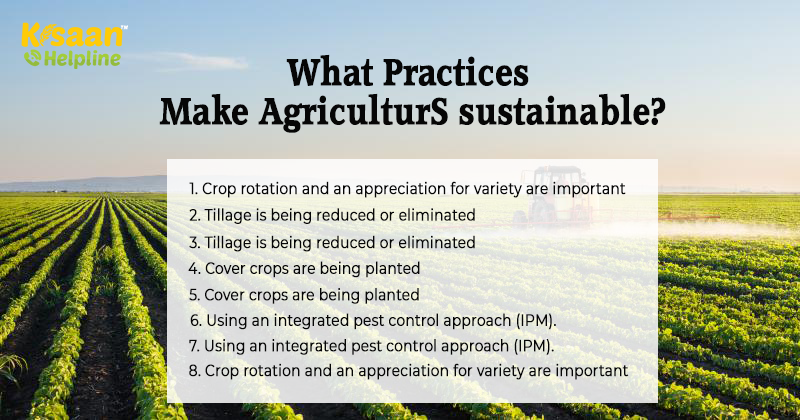
1. Crop rotation and an appreciation for variety are important


Many advantages may be gained by planting a variety of crops, including better soil health and improved insect management. In addition to intercropping (growing a variety of crops in the same region) and complicated multi-year crop rotations, crop diversification techniques.


2. Tillage is being reduced or eliminated


Traditional plowing (tillage) prepares fields for planting and helps to minimize weed issues, but it may result in significant soil loss if done incorrectly. No-till or reduced-till techniques, which include putting seeds directly into undisturbed soil, have the potential to decrease soil erosion while simultaneously improving soil health and fertility.


3. Cover crops are being planted


Cover crops, such as clover or hairy vetch, are sown during the off-season when soils would otherwise be left naked and exposed to the elements. These crops help to preserve and improve soil health by avoiding erosion, replenishing soil nutrients, and keeping weeds under control, thus decreasing the need for herbicides and other pesticides.


4. Using an integrated pest control approach (IPM)


There are a variety of techniques that may be used to keep pest populations under control, including mechanical and biological controls, that can be administered in a systematic manner to reduce the usage of chemical pesticides.


5. Adoption of agroforestry techniques is encouraged


Incorporating trees or shrubs into their operations allows farmers to provide shade and protection for plants, animals, and water supplies, while also possibly earning extra money from the plants and animals.


6. Bringing animals and crops together


Traditionally, industrial agriculture has kept plant and animal production separate. For example, animals are kept far away from the regions where their feed is generated, and crops are grown far away from areas where there is plentiful manure fertilizer. In recent years, there has been an increase in evidence suggesting the intelligent integration of agricultural and animal production may be a formula for more productive and profitable farms.


7. Managing entire systems and landscapes is a difficult task


The uncultivated or less intensively cultivated portions of a farm, such as riparian buffers or prairie strips, are treated as essential parts of the farm, appreciated for their roles in erosion management, nutrient runoff reduction, pollinator assistance, and other forms of biodiversity support.


8. Emphasizing on diversification


Many of these strategies have one thing in common: they all emphasise diversification. If you want anything done well, it's best to keep things as simple as possible. But when it comes to agriculture, the best systems are more diverse and complicated, much like the rest of nature.


Agriculture science for a sustainable future


Agroecological techniques may help farms be more productive and lucrative, according to the most recent scientific evidence—much of it coming from research institutions in the nation's bellwether agricultural states.


It is also critical to the success of a more sustainable agro ecological system for farmers to have access to a diverse range of crop varieties that can be easily adapted to farm-specific conditions and practices. Crop breeding research is one of the most important areas of research in agriculture today.


Breeding research efforts have been curtailed in recent years, leaving farmers more dependent on a small number of cultivars that are specifically adapted to the requirements of industrial farming operations.


It is critical that we continue to fund agroecology research, as well as outreach and education to enable farmers to make good use of the knowledge in order to assist farmers in adopting sustainable practices.


Final Thoughts


Crop reminder voice calls are sent by Kisaan Helpline in the farmer's local language and are specifically designed to meet the farmer's specific crop needs. As a consequence, farmers were provided with information on the best crop consulting services available, as well as the right input dosage. As a bonus, it gives farmers the ability to purchase inputs directly from our App and sell their products straight to the Kisaan hotline through the app, cutting out the middleman and enabling them to sell at mandi rates.

Monday, 27 September 2021

The agriculture trade platform and markets have changed dramatically in recent years


Trade is critical in the delivery of food and clothes to customers all around the globe, especially in developing countries. As well as contributing to more consumer choice, it has played a part in decreasing food insecurity across the world.


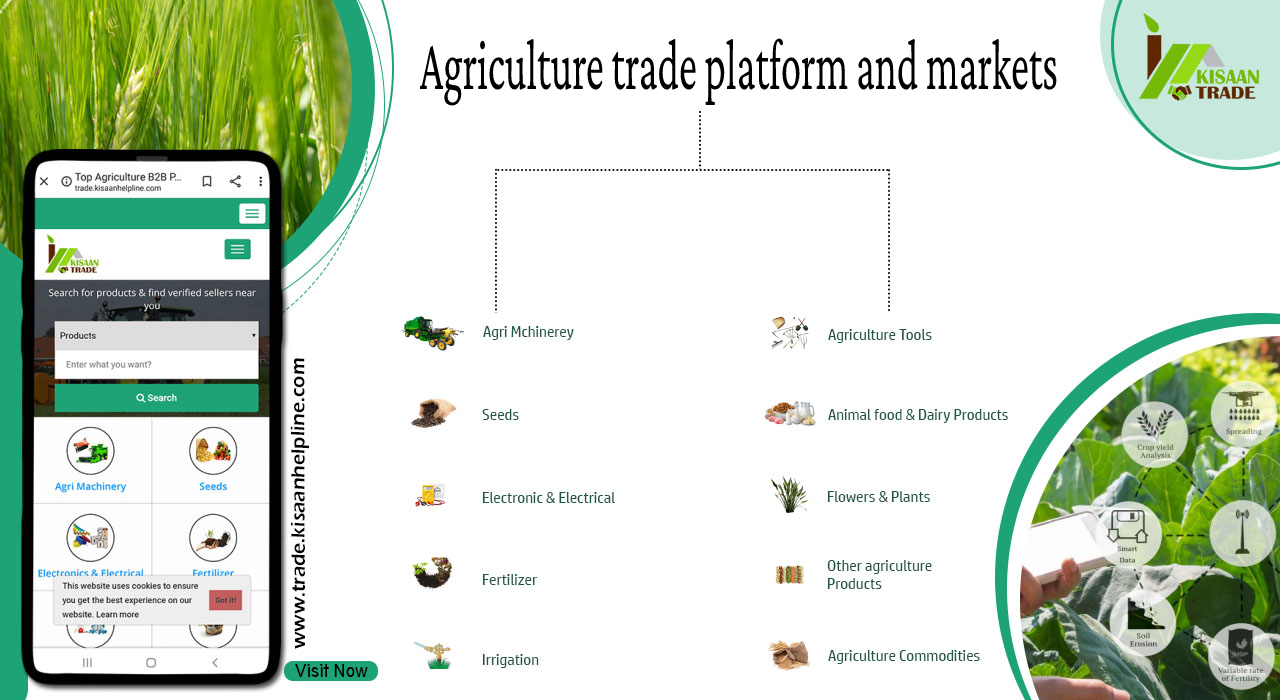
Farmers may Buy or Sell Seeds, Fertilizers, Farming Equipment, and other Agricultural equipment and products at the lowest possible price on Kisaan Trade, India’s Largest Online Agriculture Trading Marketplace. Kisaan Trade’s goal is to provide its users with a real-time, transparent product marketplace.


What statistics have to say about this rise in agriculture trade platform


Over the last decade, many developments have occurred in the worldwide agriculture and food markets, resulting in tighter integration of local and foreign markets. Agricultural trade has increased significantly since 2000.


Significantly more than in the preceding decade, with annual growth rates of close to 8 percent in real terms between 2001 and 2014, as world markets responded to an increasingly rules-based trading environment, falling tariffs, and reductions in trade-distorting producer support. 


Agriculture trade platform is getting global


However, the agro-food trade and agriculture trade platform are not only growing, but it is also getting more “global.” In recent years, the food and apparel that customers find in their local shops have increasingly been manufactured from a wider variety of goods that have been produced in a greater variety of places across the world. 


There has been a substantial rise in trade between rising and developing nations, which are becoming more important as suppliers and customers for agro-food goods, among the changes in agro-food markets.


Global value chains (GVCs)


 As commerce has grown, so has the global food system, which has become more integrated due to this expansion. Agricultural and food processing value chains that span multiple nations are becoming more important in global agro-food commerce. Global value chains (GVCs) connect agro-food sectors and other sectors of the economy from across the globe, resulting in a rising proportion of agro-food trade.


Trade and domestic support policies impede trade and the increasing integration of agro-food markets.


● Despite the evolution of international agro-food markets, most nations continue to offer assistance and impose obstacles via policies that distort trade and restrict the advantages that international agro-food markets may provide for consumers. 

● These policies continue to have substantial and severe consequences for the welfare, resilience, and food security of consumers and farmers, as well as for the long-term viability of agriculture. 

● They also have the additional impact of reducing the amount of agricultural and food commerce.

● Furthermore, although many trades and domestic support programs aim to increase food production, there is no evidence that they are successful in accomplishing this goal: worldwide agricultural and food output would rise if distorting subsidies were eliminated.


Because of the new and tighter ties that have been established between the agricultural and food sectors, as well as between these and other sectors of the economy, the effects of trade and domestic support measures are being communicated more broadly. 


It is when everyone works together that the biggest advantages of change are realized.


Countries at all levels of development have a larger shared interest in ensuring that international agricultural and food markets are free of distortions as regions and sectors become increasingly internationally interconnected.


When all nations – developed and developing – work together to decrease trade-related and domestic support, the benefits of reform are the highest. Price reductions for consumers in developed nations are accompanied by a shift in manufacturing to more efficient industries in these regions. Some nations have seen significant benefits as a result of changing their anti-competitive laws.


When all nations decrease trade-related and domestic assistance, the welfare benefits to developing countries are substantially greater than when no countries reduce support. Developing nations’ ability to reap advantages from reform is important since the actions of other developing countries – reflecting the growth in “south-south” trade – are vitally connected to those of the first.


Final Thoughts


Finally, policies have an impact on the benefits derived from agricultural and food commerce.

At the Organization for Economic Cooperation and Development (OECD), we examine the effects of trade and agricultural policies in order to assist nations in making informed policy choices that will help make agro-food trade work for everyone. Countries’ trade policies that limit trade or raise trade costs needlessly damage their own domestic economies as well as the economies of their trading partners by impeding the growth of the agro-food industry are detrimental to both.


Countries should decrease their own trade-distorting domestic support and their trade measures, such as tariffs, to increase the benefits of trade for agro-food industries. These policies decrease a nation’s export competitiveness by raising the cost of inputs, and they may also make it more difficult for the country to engage in agro-food GVCs.


Kisaan Trade: India’s Biggest Agriculture Trade platform


Kisaan Trade, India’s Largest Online Agriculture Trading Marketplace, also has the country’s most recent online agriculture e-magazine, which covers biotechnology, seeds, farm mechanization, horticulture, bio-agriculture, ICT, research, and other topics. Kisaan Trade, India’s Largest Online Agriculture Trading Marketplace, has maintained a large following over the years due to its extensive content and unique and aesthetically attractive presentation of essential information.

Saturday, 25 September 2021

Empowering sustainable agriculture in India


The agricultural industry in India is at a critical juncture in its development and change. It is still the most distinguishing era in India's agricultural sector, marked by the introduction of intensive modern farming methods, high-yielding variety (HYV) seeds, and high-yielding fertilizers during the green revolution.


However, as public awareness of food safety and sustainable farming grows in India and across the globe, it is essential that the country's agricultural industry reimagines its future path. With this aim of Empowering Sustainable Agriculture in India, Kisaan Helpline is being created as a one-stop-shop for all informational requirements of an Indian farmer. The Indian Farmer will no longer have to navigate through a maze of websites designed for various purposes.


Empowering Sustainable Agriculture in India


Agriculture is often referred to as the "backbone" of the Indian economy because it provides a living for 42 percent of the country's workers. It makes up 19.9 percent of the country's gross domestic product, demonstrating its importance to the economy.


Agribusiness, which is one of the world's oldest and most labor-intensive sectors, requires resilience and innovation to guarantee the sector's long-term viability and long-term viability. COVID-19, without question, has heightened the urgency of changes in the agricultural sector in the coming years.


Increase in people working in Horticulture


An increase in the number of people working in horticulture, which is the most important sector of agriculture, has been seen over the past decade. It contributes to 30 percent of agricultural GDP and is expected to continue to increase in the next few years.


Plant breeding and horticulture have continuously ranked high on the priority list in India's overall agricultural policy framework. As a result, overall horticulture output is expected to reach 327 million tone’s in 2020-21.


Impact of Climate change


The negative effect of climate change, on the other hand, has a disproportionate influence on this important industry. In recent years, natural disasters of extraordinary proportions have occurred, including drought, pandemic, cyclones, severe storms, and flooding.


Climate change causes unpredictable weather, which makes it more difficult to produce goods and services. This results in increased usage of pesticides and chemicals, which in turn contributes to additional environmental deterioration, producing a vicious downward cycle.


Food traceability


Food safety, safe and sanitary food handling, and the adoption of sustainable agricultural techniques are all becoming more important to customers and markets at the same time.


For example, food traceability is gaining popularity at an alarming rate. Consumers may learn more about where, when, and who produced the crop as a result of this level of technical complexity, which also includes giving footprint data of the crop's journey from pre-harvest to the market shelf.


This enables customers to distinguish between "safe food" and "unknown fruit," thus providing an important market opportunity to ensure that farmers get remunerative returns/premiums for adopting and implementing sustainable farming methods.


Farmer-to-consumer supply chains are the most important link in the chain connecting consumers' demand for "safe and sustainable food" with farmers' capacity and willingness to produce that kind of food.


Value chains from farmers to consumers


It is also, in many cases, the only way to stop the vicious cycle and begin a virtuous one. Not only is openness in the manufacturing system essential to gaining customer confidence, but reducing waste in the supply chain is also the most straightforward (thanks to current technologies) and has the greatest effect (we will need to produce 25 percent less).


As a result, integrating value chains from farmers to consumers is the key to addressing one of the most difficult problems that humanity is now facing.


The beneficial effect that these linked value chains are having is already apparent in the marketplace. For example, the advancements in the banana value chain over the past decade have paved the path for future improvements.


Lack of infrastructure


India is the world's biggest producer of bananas, accounting for more than a quarter of worldwide output in 2010, despite having no presence in global commerce a decade earlier.


This was owing to insufficient farm-level production methods, insufficient quality standards, and a lack of infrastructure, among other factors. As a result of sustained efforts in developing this value chain, exports have increased to moreover 300,000 tonnes per year, making it India's biggest fruit export by volume.


The implementation of a contemporary package of techniques, the implementation of a 100 percent drip irrigation system for water conservation, the increase of productivity by 30 percent, and the compliance with global food safety and quality requirements were all necessitated as a result.


The development of infrastructure, the implementation of end-to-end traceability, and packaging improvements all contributed to an increase in more than 50% of the shelf life. As a result, organizations were able to reduce their waste to less than 2 percent, well below any other global standard in the process. The increase in revenue of farmers has been as high as 100 percent, which has enabled all of this.


As more and more agri-tech companies and creative organizations spring up, the technology and creativity needed to enable sustainable food production and consumption will continue to develop as a result.


It is now possible to implement drip irrigation systems that will help conserve water; safer chemicals, precision agriculture that will help ensure that food is safe to eat; innovative packaging, cold chain infrastructure, traceability systems, and improved transportation that will help reduce wastage; and many other initiatives.


Agri-reforms for farmers to adopt sustainable practices is the need of the hour


Agri-reforms for farmers to adopt sustainable practices are required, as is the promotion of organizations that can have a large-scale impact (rather than just isolated pockets of excellence), the education of consumers and farmers, and the transformation of the agriculture sector away from a production-driven to a demand-driven, sustainable farming methodology on a large scale, among other things.


With the advancement of sustainable agricultural methods, the prospects for their promotion in India are growing more favorable. Modern agri-tech companies may play a critical role in empowering farmers, promoting sustainable agricultural practices, reducing crop losses, deepening local and international market links, and increasing farmer income, among other things.


Final Thoughts


Farm interventions powered by technology and improved climate forecasting skills will assist in the reduction of crop loss and the mitigation of the problems presented by climate change.


Our resolve to regulate and improve agricultural production, maximize farmer income, and increase knowledge about food safety on a broad scale will also guarantee the sector's long-term viability. With this aim of Empowering Sustainable Agriculture in India, Kisaan Helpline is being created as a one-stop-shop for all informational requirements of an Indian farmer. The Indian Farmer will no longer have to navigate through a maze of websites designed for various purposes.