Saturday, 18 February 2023

The Best Agriculture Website in India's secrets have been Revealed


You need to have at least a basic online presence to compete in the modern market. I would say that having a website and a Facebook page is the absolute minimum for farmers. A strong return on investment is provided by having an online presence. A farm website is unquestionably one of those options. It can be very difficult to keep up with the amount of information available online and the options you have for connecting with your customers. It would be convenient to be able to update numerous social media accounts and run a sizable blog from your office. Nonetheless, a small investment of time and mental energy will pay off handsomely for your agricultural business.


Websites devoted to agriculture are crucial because they offer resources and a wealth of information to farmers and other professionals in the field. Access to these websites may be possible through:


1) Industry news and updates: Agriculture websites can inform farmers and other professionals in the field of the most recent trends and developments in the market, new technologies, and government regulations.


2) Technical and research data: These websites can give farmers and other professionals in the field access to technical data, research reports, and best practices for managing crops, livestock, and other agricultural activities.


3) Government resources and services: Numerous agriculture websites offer details on policies, rules, and initiatives that are pertinent to the sector, such as conservation and disaster relief initiatives.


4) Market prices and trends: A few websites dedicated to agriculture offer data on market prices and trends that can assist farmers in choosing the best times to plant and harvest their crops.


5) Connectivity: Some agricultural websites can link farmers with other farmers, subject matter experts, and agribusinesses, enabling them to share knowledge, benefit from one another's experience, and make better decisions.


Concerning Kisaan Helpline


The Kisaan Helpline's main objective is to spread information gleaned from agricultural research, knowledge, and experiences throughout the agricultural world in order to aid in the development of agriculture through the use of information technology. Our one and only goal is to compile all the information onto one online platform, connect with the farmers, and empower and inform them.


Kisaan Helpline, one of India's top portals for agricultural service providers, helps rural communities improve the productivity and sustainability of their agricultural operations. We support farmers in becoming more integrated, connected, and knowledgeable than ever. From land preparation, seeding, and sowing to plant nutrition and protection, we provide you with specialised knowledge that lasts through post-harvesting. We are the top agricultural service provider in India, assisting you in decision-making on the farm, enhancing performance, forecasting future events, and acting more successfully as predicted.


What sectors do we work in?


1) Indian Crops: Kisaan Helpline is an online portal that provides services to the agriculture industry. It offers information on Indian crops such as rabi (wheat, garlic, chickpea, cumin, onion, mustard, rabi vegetables, pea, opium, coriander, barley, strawberry, and oat) and kharif (urad, cotton, maize, onion, vegetables, ginger, rice, moong, sorghum, and pearl millet). The purpose of all the information mentioned is to give specifics regarding crop name, variety, yield, and fundamental questions.


2) Agricultural Events: Farmers can obtain additional information about agriculture through these events, such as soil testing, training, crop protection, crop nutrition, seeds, agricultural news, articles, advice from agricultural experts, and solutions. On the Agro Expert Forum of the Helpline, farmers can offer suggestions, solutions, articles, their opinions, and agricultural information pertaining to crop protection. The goal of the Kisan Helpline is to encourage agricultural consultants and experts to share their knowledge with others while also keeping their opinions to themselves. This will aid in guiding farmers by promoting their concepts, articles, and agricultural knowledge.


3) Agriculture Training: A programme that offers education and training to people interested in a career in agriculture is known as an agricultural training program. These courses may be offered at universities, colleges, or other academic institutions and may deal with a variety of agricultural subjects, such as:


• Crop production: This can include details on how to plant, fertilize, and harvest various kinds of crops as well as methods for preventing crop damage.

• Livestock management: information on raising, feeding, and taking care of various kinds of livestock can be found in the category of livestock management.

• Soil science and agronomy: Information on soil fertility, soil conservation, and other areas of soil science can be found in the field of soil science and agronomy.


4) Agricultural Digital Magazines: An Indian agricultural digital magazine called Kisaan Helpline offers resources and information to farmers and other people who are interested in the agricultural sector. The magazine covers a wide range of subjects, such as improvements in agricultural technology, farm management, crop and animal production, and marketing and business strategies. They also give farmers the most recent information on government policies and programmes. They cater to a wide range of farmers because of their emphasis on Indian agriculture and availability of information in both Hindi and English. It is simple for farmers to access the information they require, even while they are in the field, because Kisaan Helpline is accessible both online on their website and through a mobile app.


5) Organic Farming: In order to grow crops and raise animals without the use of artificial fertilisers, pesticides, or other chemicals, organic farming emphasises the use of sustainable, natural methods. It is founded on the usage of natural resources, ecological balance, and biodiversity principles. Crop rotation, green manures, and biological pest control are methods used by organic farmers to maintain soil fertility, manage pests, and increase crop yields.


Animal welfare is a major component of organic farming, and farmers who practice it are required to give their animals access to pasture, clean water, and enough room to roam in a healthy, natural environment.


Conclusion


As an outcome, Kisaan Helpline is a useful tool for farmers, ranchers, and other people interested in the agricultural sector, particularly in India. The online publication offers a wealth of knowledge on a variety of farming and agricultural-related subjects, such as crop and animal production, farm management, marketing and business tactics, and advancements in agricultural technology. It's a great tool for farmers to stay informed and make informed decisions because they also get the most recent updates on government policies and programs. They also provide information in Hindi and English and place a strong emphasis on Indian agriculture, making it useful to a variety of farmers.

Smart Farming Solutions with the Future of Agriculture App


The emergence of technology and digitalization over the past few years in every industry has shown the potential transformative impact of enormous advancement. Rural residents are embracing digital solutions as well, not just urban ones. In India, their share has recently soared to 48%. We can safely conclude that there has been an influx of smart farming technology that has brought about some significant innovations in the day-to-day lives of farmers, given that the majority of the rural population comes from a farming background. The most recent technological advance in agriculture is smart farming. Since the beginning of time, farmers have used technological advancements to modify their farming methods to suit the needs of the times.


Smart farming is a concept of farm management that automates inputs and improves the quality and quantity of outputs using agtech, agritech, or modern technology. The agriculture app for farmers, which was created specifically with features to increase agriculture efficiency, is one way that farmers can incorporate smart farming. The advanced features needed for farmers to make wise decisions on their farms are built into smart agriculture apps. Let us now consider the significance of smart farming solutions in the future of agriculture apps.


How Does a Smart Agriculture App Benefit Farmers?


The need for food rises along with the world population. It is no longer possible to categorize as traditional the profession of farming, which has existed since the beginning of time. Why? Because maintaining the status quo will make it challenging to feed the population of the future. Farmers all over the world are already shifting their practices to become more digitally oriented.


Earlier, farmers continued to practice what they had been doing for years due to a lack of information and other factors. However, with the idea of "smart farming," they now have the opportunity to manage their farms and maximise their yields using technology.


1) To make effortful, cost-effective farming decisions: Instead of basing farming decisions on theories and concepts, smart agriculture apps strategically use technology and digital technologies to detect crop variability and manage crops accordingly. This saves time and money compared to traditional farming methods.


2) To increase output: Using a smart agriculture app, farmers can maximise their output. Farmers can be sure to produce more sustainably with the use of smart farming techniques because the smart farming app enables farmers to be present when their crops need them most, all from the convenience of their smartphones.


3) To advance technologically: Agricultural technology and smart farming are intertwined in terms of technological advancement. The use of technology in agriculture will assist farmers in applying pesticides, fertilisers, and other agricultural inputs selectively and in the necessary quantities in specific locations, potentially reducing the need to apply these inputs uniformly across the farm.


4) Weather forecasts and data on soil analysis: It can be found on the app, which can assist farmers in making more informed choices about when to plant, fertilize, and harvest their crops.


5) Planning irrigation: Using information about the weather, crop growth stages, and soil moisture levels, the app can assist farmers in creating the most effective irrigation schedules.


6) Market prices and demand: The app can assist farmers in monitoring market prices and crop demand so they can make more educated choices about when to plant and harvest.


7) Labour Management: Utilizing the app, farmers can assign tasks to various workers and manage their labour force.


8) Inventory Management: The app can assist farmers in managing their inventory, which includes inputs like seeds, fertiliser, and pesticides as well as outputs like harvested crops.


Kisaan Helpline: What is it?


A dedicated digital platform to enhance farmer life and support sustainable agriculture Kisaan Helpline, one of India's top portals for agricultural service providers, helps rural communities improve the productivity and sustainability of their agricultural operations. We support farmers in becoming more integrated, connected, and knowledgeable than ever. From land preparation, seeding, and sowing to plant nutrition and protection, we provide you with specialised knowledge that lasts through post-harvesting. We are the top agricultural service provider in India, assisting you in decision-making on the farm, enhancing performance, forecasting future events, and acting more successfully as predicted.


Why choose us?


1) Data Gathering


For the most recent update, we had a strong research team. KH maintains data going back years to assist farmers in resolving problems with crop management.


2) Innovation


Our upcoming AI will be accessible to farmers around-the-clock. Farming requires innovation, and we are enthusiastic innovators.


3) Live support and solutions


Using Salah and Samadhan is a special method for answering farmers' questions.


Features of our smart and farmer-friendly app, Kisaan Helpline


1) A system for managing a supply chain


Integrating planning, execution, and control of agricultural-related activities can help farmers produce and deliver goods more effectively. Farmers can use it to better plan their farming operations and increase yields.


2) Weather predictions


A very important feature that farmers look for in a farming mobile app is a weather forecast, which is extremely important for agricultural activities. The accuracy of this data can aid farmers in being ready for any unforeseen circumstances.


3) Individualized crop management and scheduling


Every farmer and every field has different needs for growing crops. Farmers can feed their data into this feature of a smart agriculture app to get a crop schedule for all upcoming activities. This makes it easier for farmers to manage their crops and themselves.


4) Financial Insights


Farmers struggle to accurately manage profits and losses on their farms. Farmers can effectively understand their gains and reduce losses when and where necessary with the help of this feature. A smart agriculture app with this feature brings the farmer one step closer to downloading.


5) Support in agronomy


Farmers require support in agronomy at all stages of the crop cycle. Crops suffer substantial losses due to pests, diseases, and occasionally abrupt environmental changes. But prompt guidance can assist farmers in avoiding it. When a problem arises, this feature in a smart agriculture app can make it simple for farmers anywhere to contact an agronomist.


Conclusion


In conclusion, agriculture apps have a promising future because they give farmers useful resources and knowledge that can boost their farms' productivity, efficiency, and profitability. These apps will probably become even more advanced and feature-rich as technology develops. Additionally, as more farmers use these apps, a wealth of data will become available to boost the accuracy and decision-making abilities of these apps. Furthermore, smart agriculture apps can be extremely helpful in achieving this goal due to the growing demand for farming methods that are environmentally friendly and sustainable.


Farmers can get access to a variety of services and information from the Kisaan Helpline that can help them improve their farming operations. These services offer crop management tools, market prices, weather forecasts, and other useful data that can assist farmers in making better decisions. Additionally, the Kisaan Helpline can give farmers access to professionals and other resources that can assist them in resolving issues and overcoming difficulties. Additionally, the helpline can be used to link farmers with other farmers, governmental bodies, and other organisations that can offer assistance and support. Overall, the Kisaan helpline is a valuable resource for farmers, assisting them in raising their standard of living and creating a more resilient and prosperous agricultural sector.

Friday, 17 February 2023

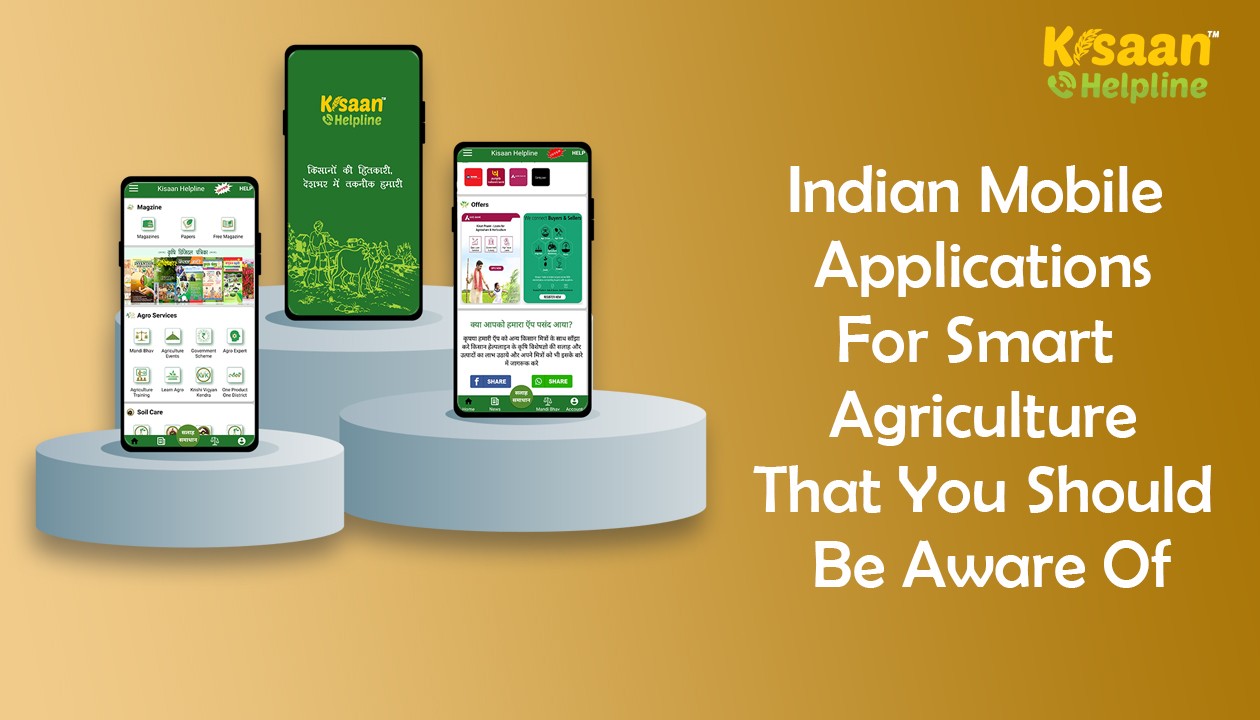
Indian Mobile Applications for Smart Agriculture that you should be aware of


When we hear the word "agriculture," images of tractors, bullock carts, and laborers toiling away in the fields come to mind. But times have changed, and technology is now permeating the agricultural industry. There is a lot that can be done using the power of technology, ranging from high-tech ways to identify the best-quality seeds to the best agricultural processes. At the same time, it is anticipated that the use of technology will boost farmer income. When it comes to technology, modern farmers are now using cutting-edge equipment, top-notch tools, and even some software to improve the quality of their farming. But one of the best and most practical applications of technology is the advent of mobility.


The introduction of cloud-based and mobile applications


In this stage of civilization, it is becoming increasingly difficult to find raw materials and resources. The sustainability challenges that lie ahead are acknowledged as real when we take into account the pollution, rising emissions, soil deterioration, and water shortage. But recently, 3G mobile networks have started to appear all over the world, adding to this same scenario.


Despite the apparent disconnect between agriculture and mobile app technology, there is growing evidence that using mobile and cloud-based applications not only addresses these sustainability challenges but also generates revenue for both large agriculture-based companies and smallholder farmers.


Such portable wireless devices and mobile technology have sparked the development of cutting-edge services and applications that are used in both developed and developing nations' agricultural supply chains. There are differences in how these technologies are being adopted in these two markets. Mechanization is more advanced, and the agricultural labour force is significantly smaller in developed nations.


What are the advantages of mobile apps and technology for farmers?


With the aid of cloud computing, integrated IT systems, online education, and the widespread use of mobile phones, it is now simpler to disseminate agriculturally related information to farmers in the poorest communities. Farmers can make better land management decisions thanks to such connectivity and information flow, which is one of their many advantages.


For instance, it can make it possible to monitor soil condition in conjunction with weather data to better plan the planting and harvesting seasons. Similar to this, farmers can use geographic information systems to provide proactive information on pests and animal diseases so they can react in line with the level of risk. Utilizing cloud and mobile computing can also help optimize the use of water, seeds, and fertiliser.


Do small-scale farmers who own land use mobile apps?


Regardless of the size of their land, mobile apps for farmers can have a big impact on them. Smartphone agriculture apps can help farmers of all sizes, whether they have a few hundred hectares of land in rural Argentina or just an acre in India, solve their problems.


Governments are attempting to connect with farmers today by using agricultural smartphone apps, especially in developing nations. With the aid of cloud computing, integrated IoT systems, and online education, things are relatively easier when it comes to disseminating information about agriculture and connecting with farmers in the poorest communities.


In relation to Kisaan Helpline


Farmers can purchase all agri-inputs and services (such as soil testing and training) through Kisaan Helpline, a dedicated platform with more than 300 product options and 25+ agro-experts. Farmers can easily and quickly receive high-quality products at the village without taking any risks. A group of ardent businessmen founded Kisaan Helpline in 2014. Kisaan Helpline, India's largest agricultural input marketplace, delivers a wide range of high-quality inputs, training services, soil testing, and other services directly to farmers' doors.


By utilising its technology offering for farmer empowerment, Kisaan Helpline is bringing access to high-quality agricultural products and individualized advice.


What makes the Kisaan Helpline unique?


1) Agricultural News: Farmers need news about their industry, and they also want to know how valuable farming is right now. Because of this, we regularly update news and ideas on the Kisaan Helpline portal. We publish the news in both Hindi and English so that farmers can read and understand it easily. We are working to make it compatible with every regional tongue. Our new system is very effective, and agricultural informatics is helpful.


2) Market Price (Mandi Rate): Farmers are always interested in learning how much their crops are worth on the market (mandi). We are giving farmers the best option because they always want to get the best price for the crop. Farmers can access the current market price on a daily basis in our portal.


3) Training in Agriculture: The Kisaan Helpline seeks to inform farmers. We oversee a highly desirable platform for farmers. We have arranged every type of agriculture training programme in this section. The user can learn about every aspect of agriculture. Because farming is such a vast and profitable industry, we are developing a programmed that is both appealing to and appropriate for farmers. From here, they can learn precise information.


4) Suggestion and Solution: Farmers need to communicate their problems, issues, questions, and suggestions, but they are unsure of how to do so. Farmers can ask any questions in this section with ease, and our knowledgeable team will respond to all inquiries. This serves as a system of support. Farmers can receive a precise answer in a timely manner.


5) Farming Method: Farmers who use the incorrect method are unable to produce crops of the expected quality and are therefore unable to charge the correct price for their produce. Therefore, the expert team at Kisaan Helpline will give you the best farming technique. Farmers can easily obtain accurate information about farming methods. Our experts will give you the best advice and information.


6) Digital Magazine: Kisaan Helpline also offers a section of digital magazines to help farmers advance their knowledge. Farmers can read our online digital magazine after following the strategy of the traditional farming method to improve their farming operations. We have a very unique assortment of extremely rare magazines, which are unavailable online or in physical stores. Digital magazines are easily accessible to farmers. The farming method is very well supported by digital magazines. For your benefit, our knowledgeable agro-scientists also advise doing this.


Bottom Line


The Kisaan Helpline, which offers a variety of services and information that can help farmers improve their farming operations, is a valuable resource for farmers. Using the helpline, farmers can get access to weather forecasts, market prices, crop management tools, and other helpful data that can help them make better decisions.


Numerous farmers use mobile apps to carry out their daily tasks. The introduction of mobile apps has demonstrated many useful advantages in the agricultural sector, ranging from improved land management decisions to high-quality yield. Farmers have even begun utilising various mobile applications to assess the health of the yields throughout the crop cycle.


Additionally, some of the most recent mobile apps are used to make crucial farming decisions regarding the use of pesticides and fertilisers. Farmers now have the advantage of basing their decisions on research rather than just gut feelings or custom.

Friday, 23 December 2022

How to Get the Most Out of the Best Agriculture Mobile App


Based on the nexus of cybernetics and agronomy, agriculture software is a relatively recent and beneficial digital discovery. Digital applications make the lives of agrarians easier. Because of their clever innovations, their business is more relaxed, predictable, certain, and profitable.


The farm management system enables farmers to complete numerous daily management tasks in an easier way. Technologies of all kinds are developed to assist people in quickly reaching important decisions.


What effects has the world of mobile communications technology seen?


The most popular method for transmitting data, voice, and various services in use today is mobility, which has grown quickly. Due to the exponentially high rate of growth in mobile device use, businesses are starting to look into how they can make the most of mobile technology to grow their operations. Using apps is undoubtedly the best way to provide clients with information and services. The use of kisan helpline mobile application enables businesses to more effectively and individually reach a larger audience. Mobility has completely changed every industry, from retail to banking to healthcare, and it is now moving toward the agricultural sector as well.


Are mobile apps the most suitable technology for today's agricultural industry?


The sheer number of mobile applications on the market is overwhelming the world! There is a lot that a mobile phone is capable of doing, from the retailers who are eager to use their phones for business purposes beyond just talking or texting to the modern-day farmers who use them to search for necessary information.


Some recent studies make it crystal clear who uses which service and what the users' needs are. The creators of mobile applications are figuring out how a specific service will fit into the lives of farmers. As a result, they are developing apps with services that will be extremely helpful for the farmers.


Farmers' lives now revolve entirely around mobile applications


Numerous farmers use mobile apps to carry out their daily tasks. The introduction of mobile apps has demonstrated many useful advantages in the agricultural sector, ranging from improved land management decisions to high-quality yield. Farmers have even begun utilising various mobile applications to assess the health of the yields throughout the crop cycle. Additionally, some of the most recent mobile apps are used to make crucial farming decisions regarding the use of pesticides and fertilisers. Farmers now have the advantage of basing their decisions on research rather than just gut feelings or custom.


Introducing the Kisaan Helpline App


The Kisaan Helpline Mobile Application is a unique Kisan platform that offers farmers one-stop shopping for services. The village-level online platforms that make up Kisaan Helpline combine to offer a variety of services to farmers at the moment. With the assistance of more than 1.5 lakh farmers throughout India, Kisaan Helpline has established a niche for itself in the field of conscious and intelligent farming. A comprehensive and cutting-edge agriculture platform, the Smart Kheti and Krishi App for Farmers, links farmers and regular citizens from rural communities across the nation and assists them in producing high levels of productivity from their work and managing it effectively.


Here, we list the characteristics that the Kisaan Helpline mobile application must have:


• Weather forecasts: These inform farmers of the current weather conditions so they can adjust their farming practices.

• Livestock management: managing various livestock, including tracking their output and other tasks.

• GPS or location-based services would be beneficial for farmers.

• Broadcasting and video calls—to enable farmers to consult specialists via video calls. By broadcasting, they could build a community within the app where they could exchange useful advice or gain insight from other farmers' experiences.

• Support: To get responses to their questions from professionals.

• Calendar: For planning and monitoring various activities related to crops.

• Push notification: To get immediate alerts on various events or when a professional sends them a message.

• Organizing and maintaining a record of the pesticides, seeds, equipment, and other agricultural supplies

• Payment gateway: farmers can use this to purchase products from an online store.

• Crop information—to inform farmers of crop diseases, issues, and solutions.


The following list outlines the main characteristics of the Kisaan Helpline:


1) Keeps track of income and expansion


In modern farming, the days of recording your activities and expenses on a piece of paper are long gone. Spreadsheets aren't always the most effective way to gather and manage data. You can increase the productivity of your farm's financial operations by implementing software for agriculture management.


2) Measures of performance and risk


Field performance analysis can be a helpful tool for determining risk if you raise crops on your farm. You'll find it simpler to make future plans if you can look back on past corporate decisions. One aspect to take into account when assessing field performance, predicting yields, and estimating sale prices is input costs. You can organise data with the aid of a farm management system to help you make better business decisions.


3) Allows for simple data access


You must have access to information if you want to operate a profitable farming operation. On a daily basis, farm operations frequently involve a number of people. Farm staff can track crucial data that the farm owner can keep track of using farm management software.


4) Functions as a Growth Accelerator


The technology used in farm management systems is intended for the progressive farmer. A number of management systems can be accessed using tablets and smartphones. These features allow users to farm while they are on the go. The best farm management systems typically come with an annual fee to use them, but this is frequently a small price to pay when trying to expand your farm. Farming becomes more productive and profitable thanks to the use of farm management software.


Conclusion


Experts in agriculture and our team provide free access to all farming-related information for farmers. With over 25 agriculture experts, Kisaan Helpline offers a wide variety of information about more than 160 different types of crops and varieties, including phal-phal, herbal, Rabi, Kharif, and more. Crop seed selection, seed treatment, seed variety, soil testing, field and soil preparation, nurseries, planting of plants or seeds, choice of chemical and organic fertilisers, irrigation, crop protection, insecticides, fungicides, harvesting, and other related activities Additionally, you can view the most recent market price for your neighborhood’s market on Mandi wise. You may contact us if you have any concerns related to the content of the blog.

The Benefits of Having Your Soil Tested


Soil Testing


A soil test is crucial for a number of reasons, including maximising crop production, protecting the environment from runoff and excess fertiliser leaching, assisting in the diagnosis of plant culture issues, enhancing the nutritional balance of the growing medium, and saving money and energy by using only the necessary amount of fertiliser. Analyses of pre-plant media give a hint as to possible nutrient deficiencies, pH imbalances, or too many soluble salts. This is crucial for growers who prepare their own media. An essential tool for controlling crop nutrition and levels of soluble salts is media testing during the growing season.


Why Conduct Soil Testing?


The first step in any healthy crop production programme is to determine the precise nutrients present in your farm soil as well as its pH. Depending on the health and condition of the soil, crops are typically grown on a very wide variety of soil types with varying requirements for fertiliser. By adding too many nutrients, soil can become unbalanced, which eventually affects the environment and contaminates water and the creatures that live there.


What is the pH of Soil?


On a scale of 0 to 14, the pH of a soil indicates how acidic or alkaline it is. Zero denotes extremely high acidity, whereas fourteen denotes extremely high alkalinity, and seven denotes neutrality. A farm's ideal soil should have a pH between 6.0 and 7.5. The availability of nutrients in the soil is directly impacted by a slight pH imbalance. Acidic or sour soils require the application of products containing limestone, whereas alkaline soils require the application of products containing sulphur. For proper nutrient uptake and plant health, it is essential to carry out the task gradually when adjusting the pH of a farm's soil, which may take several years.


The following are the main benefits of testing farm soil:


1) It informs the farmer of the soil's current condition and how to improve it


The soil's biological, chemical, and physical characteristics determine its fertility. The eye can see characteristics like structure, soil texture, and colour. However, it is challenging to determine the chemical makeup of soil. Soil diagnosis is necessary, which is why soil sampling is important. The pH and level of nutrients in the soil are determined through soil tests. Farmers who have this knowledge can specify the type and amount of fertiliser that will best improve the soil on their farm. This is crucial because healthy crops require fertile soils to grow.


2) Fertilizer costs are reduced as a result of soil testing


There will be no wastage of such farm inputs if you know the precise deficiency that your soil is experiencing. Farmers are prevented from wasting money on unnecessary additional fertiliser application by knowing how much and what kind of fertilisers their crops and soil require. Additionally, inorganic fertilisers' nutrients, like potassium and phosphorus, are scarce resources. Because of their limited or rather finite supply, it is necessary to use these resources carefully in order to avoid a future shortage.


3) In some cases, overfertilization has been found in soil tests


Overfertilization results from fertiliser application to soil without knowledge of the precise and actual nutrient requirements. Farmers are prevented from applying an excessive amount of fertiliser and the associated environmental damage is minimized by testing their soil first and receiving informed fertiliser recommendations. Overfertilization may cause nutrient leaching, water pollution, and irreparable harm to aquatic life. All of these detrimental environmental effects can be avoided with just a simple soil test. Furthermore, excessive fertiliser use could harm crops and the environment by causing fertiliser burn.


4) Farmers can quickly prevent soil erosion


According to research, erosion, which is brought on by improper soil management, results in the loss of more than 24 billion tonnes of fertile soil annually. Additionally, an estimated 1.5 billion people's livelihoods and health are directly impacted by land degradation. The process of restoring the soil is expensive, challenging, and time-consuming. As a result, it is simpler to improve soil management through soil testing, and applying the proper amounts of


5) Farmers who work in fertile soils can help feed the world's expanding population


The soil is under more stress than ever before thanks to the current generation. To produce the yields necessary to feed the world's ever-increasing population, fertile soils are required. Increased crop production results from better soil health, which may solve the global food security problems. Millions of people will eventually live better lives as a result of this. The first step in managing soil is soil testing. The activity provides farmers with useful knowledge that aids in improving the health of the soil; in turn, healthy soils imply healthy crops!


The value of soil testing has been understood since the beginning. In farming, it's crucial to take note of different soil types and variations in soil properties.


Farmer Advantages


There are many advantages to soil testing for farmers. Crop growth is improved by healthy soil. Before the harvest, farmers can start testing their soil to learn how they can improve it. Farmers can gain from these advantages by:


• Increasing yields and profits because you are giving your crops the nutrients they need.

• Improving the uniformity of nutrient availability throughout a field.

• Better crop growth uniformity. Additionally, this makes individual plants more resistant to weeds and streamlines procedures like cultivation and spraying.

• More constant plant maturation This can make crop drying and harvesting Easier while also enhancing market quality.

• Allowing for the precise adjustment of which nutrients are required. assisting you in allocating your fertiliser budget toward the nutrients that will increase your profits the most.


Kisaan Helpline – who are we?


A dedicated full-stack data-driven technology platform for farmers called Kisaan Helpline seeks to improve farming and farmers' intelligence. Our research-based information provides farmers with better options for 150 crops up until harvest.


We give rural youths, individual farmers, and groups the chance to set up their very own mini lab for a soil health assessment.


In order to improve soil texture and provide better plant nutrition advice, we will install a small soil lab at the block level or the closest point to the farmer's reach. We will also advocate organic farming to preserve soil.


What role does the Kisaan Helpline play in soil testing?


Mini Lab for Digital Soil Testing


An advanced soil testing kit is the digital soil testing mini lab. It examines 14 different aspects of the soil, makes fertiliser dosage recommendations for 100 different crops, prints soil health cards, has a built-in battery backup of six hours, and can be powered by solar energy.


The Ministry of Agriculture of the Government of India has approved the use of the Digital Soil Testing Mini Lab for the Soil Health Card mission.


Digital Soil Testing Mini Lab


  • Tests 14 aspects of the soil and suggests amounts of fertiliser for 100 different crops.

  • Prints Soil Testing Report with complimentary Thermal Printer

  • Sends Soil Testing Report to Mobile via Bluetooth & Computer via USB

  • Has 6-hours in-built battery back-up

  • Can be charged via solar panel

  • Complete test in short span of time

  • Can be operated by anyone after free training

  • Tests all parameters required under Soil Health Card mission


Parameters Tested


  • Organic carbon (OC)

  • Available nitrogen (N)

  • Available phosphorus (P)

  • Available potassium (K)

  • Available copper (Cu)

  • Available manganese (Mn)

  • Electrical conductivity

  • Available zinc (Zn)

  • Available Sulphur (S)

  • Available boron (B)

  • Available iron (Fe)

  • Lime Requirement Test For Acidic Soil

  • Gypsum Requirement Test For Alkaline Soil

  • pH


The following services are provided:


- An evaluation of the irrigation water's quality.

- Soil and plant testing for macro- and micronutrients.

- A thorough nutritional analysis of manure intended solely for research.

- Testing for heavy metals and other pollutants in samples of soil and plants.

- Advice on how to apply fertilisers prudently.

- A recommendation for handling problematic soils.


We sincerely hope that this article on soil testing labs has helped you learn something new, and if you have any questions at all, please don't hesitate to contact us. We're happy to help you in any way we can at the Kisaan Helpline!